
Why Some Headshots Feel Alive and Others Just Feel Posed
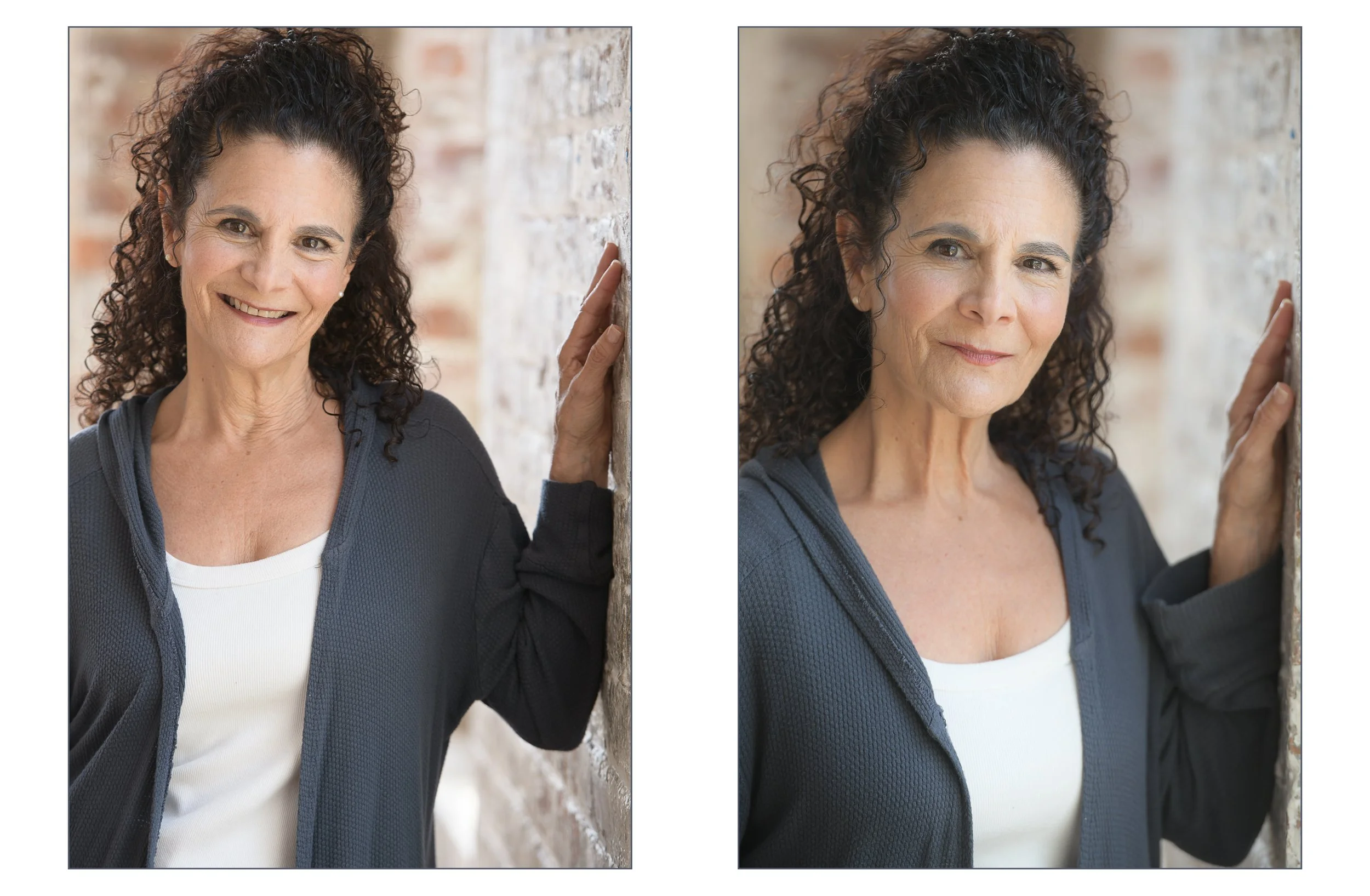
At a recent session at my Astoria studio, Denise suggested she try of those hand-on-the-brick-wall shots. Fair enough. Let’s try. Always say yes. It’s a classic shape. Classic pose. So she put her hand on the wall.
And it read exactly like that.
A person putting her hand on a wall because some goofy photographer told her to...
The pose was there. The shot was not. I mean it was fine but we want better than just fine. It was cute, it was her. It’s the shot at the top on the left.
So we changed the premise just a touch and tried again. Instead of placing her and trying to finesse the expression, I had her walk into the frame, lean on the wall naturally, look out the window, and to start watching a person across the street and create a quick backstory about who that person was to her before turning back to camera.
Same wall. Same hand. Totally different photo.
All of a sudden the shot had life in it. It felt connected. Motivated. Like something was actually happening. That’s the difference between a pose and a thought.
We did it a few times and got some great results.
A pose can help convey a general idea. A thought gives it life.
A lot of actors and photographers try to create variety in a headshot session by changing shirts, changing poses, or trying to make different expressions happen on command. That can help get a bunch of options in your session, sure. But one of the fastest ways to change a shot and improve it in my opinion, before you change clothes, is to change what is happening underneath it.
(Here’s a quick "Hack Your Headshots" moment... and whenever I say "hack," I just mean being incredibly strategic and smart with your choices.)
“If you want real variety in your headshot sessions, don’t just change the pose or the outfit. Change the thought or the intention underneath it first and see where that leads ya.”
So how do you do that?
Cast the Camera as Your Scene Partner
I say this all the time. One thing that helps an actor connect with the camera is to cast the camera as your scene partner. Not in some big acting-class way. Just enough to give the shot a real relationship.
If you change who you imagine the camera to be, or what they have just said to you, your face will usually start doing different things on its own. You don't have to paste on "warm." You don't have to indicate "guarded." You don't have to perform "funny" or "dark" from the outside. (EVEN IF your photographer suggests it by using those “unplayable” terms.) I would challenge you to instead, take the suggestion or direction, no matter how generic it’s presented to you, and translate it in your head into something you can play as an actor.
Think it. Don't show it.
It’s not theatre. The camera is right there, and it will catch the smaller shifts in your face if the thought is actually alive.
If the camera is someone you trust, that creates one kind of expression.
If it’s someone you are not sure you believe, that creates another.
If it’s someone who just surprised you, or someone you want something from, or someone you are trying not to reveal too much to, the face changes again.
This is super useful to remember because a lot of actors end up chasing variety from the outside in. They change jackets and think they have found a new lane. They try to "give" serious, then "give" warm, then "give" edgy, and all three shots somehow still feel like the exact same person doing the exact same thing.
Usually, that’s because the point of view never changed.
The Self-Tape Trap
I see the same problem in self-tapes all the time when I’m coaching actors. Casting asks for two takes, and actors send two versions of the same read, but one stresses a few words differently.
That’s not really two takes. Or helpful for them to see range.
If the point of view underneath the scene has not changed, if the relationship has not changed, if the intention has not changed, then you are mostly just decorating the same idea.
Headshots work the exact same way.
That is why I keep coming back to intention.
What just happened?
Who are you looking at?
What do you want from them?
What are you deciding?
What are you trying not to show?
Asking yourself those questions will usually get you somewhere if and when your photographer says, "Can you give me one more with attitude? or Can you twinkle it up?". Use those acting skills to ground it in something real and you’ll get better results.
The Danger of "Too Serious" or “Dead Face”
This is also where actors can get themselves into trouble by going too serious. Sometimes people hear "don't show it" and they lock everything down. Suddenly the shot gets heavy. Brooding. Solemn. Earnest in a way that feels a little airless and, well, dead inside.
That’s a danger too. If the actor takes themselves too seriously in the frame, there is no room for anyone else. Know what I mean?
There’s no invitation. No pull. No sense that anyone on the other side of the image gets to come in and participate.
Even in dramatic work, I usually think there’s gotta be a hint of a twinkle somewhere. Not necessarily a smile. Not charm for charm’s sake. I just mean something alive behind the eyes. Thought. Wit. Curiosity. Trouble. Intelligence. Some small flicker that keeps the shot from turning into a dead slab of Serious Acting.
Say you’re playing Richard III, as an audience we have to be rooting for you in some way, right? Or at least fascinated enough to stay with you. Same thing in a headshot. Even when the roles you’re targeting might be darker, more guarded, complicated, or dangerous, there still needs to be some way in. If the shot only tells me "this actor is taking this Very Seriously," well... that’s not much for me to connect to.
Finding the Point of View
So when I’m shooting, I am often way less interested in inventing a bunch of poses than I am in helping you find a real point of view and connection with the camera. And THEN we find your best angles to refine it.
Sometimes that means movement before stillness. Sometimes it means giving you a specific person to look at through the lens. Sometimes it means we’re telling a tiny story. Sometimes it means changing the relationship and seeing what that does.
That’s usually where the expressions start to vary in a way that actually feels human. And that’s the key part for me. I’m not looking for twelve different poses and “expressions”. I’m looking for different thoughts. Different currents. Different relationships.
Your face will follow.
So yes, wardrobe matters. Location matters. Framing matters. All of that helps. But if nothing is happening underneath the shot, the picture usually tells on you. That’s why some photos can look technically solid and still feel dead. And it’s why the exact same setup can suddenly come alive when the actor stops posing and starts thinking and imagining. It’s subtle but it reads.
If you are heading into a headshot session, don't just bring clothes.
Bring ideas. Bring people. Bring circumstances. Bring a little imagination.
Who is the camera in this scene? What did they just say to you? What are you not saying back? That will usually do more for the shot than one more outfit ever will.