
Co-Star Headshots vs. Guest Star Headshots: What Are We Actually Targeting?
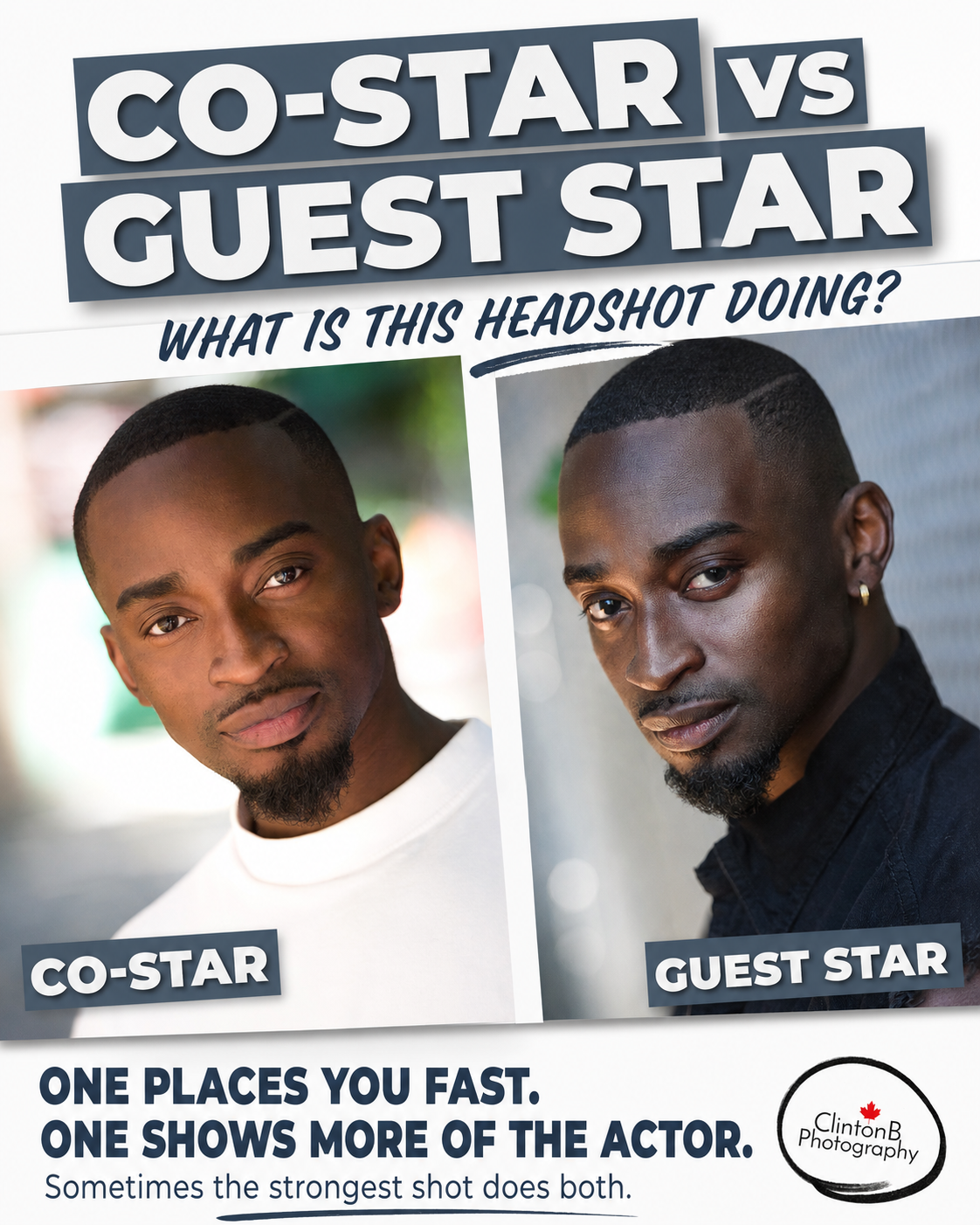
Actors often walk into headshot planning with a few broad categories in mind: something professional, something casual, maybe something dramatic or commercial.
That’s a totally normal place to start... but it can get vague really fast.
And too vague in a headshot is basically invisible.
So before we talk about shirts, jackets, colors, or backgrounds, I always like to get a lot more specific with my clients. What’s this photo actually supposed to help casting understand? Is it helping them place you quickly in a scene? Is it helping them see more of who you are as a working actor? Is it doing both?
That’s where the co-star versus guest star conversation can be incredibly useful. Not as a hard rule. Just as a planning tool.
Here’s the headshot hack: don’t start by asking, “What looks do I need?” Start by asking, “What job does this photo need to do?”
A co-star-targeted shot often needs to read fast. It needs to help casting understand, “Yes, this person can step into this world right now.”
A guest-star-targeted shot can have a little more room to show the actor as the professional they are. Your taste. Your presence. Your clothes, chosen well. Something way more specific than “generic professional person in a jacket.”
Neither one’s better, and honestly, both matter.
Sometimes you need the co-star role to keep the credits moving, build relationships with casting directors that haven’t seen your work, and yes, help make your health insurance. But sometimes you also need the shot that says, “There’s a full, complex person here. Bring me in for the bigger thing.” It sorta depends on where you are in your career and what opportunities are available to you.
Especially, if you’re just starting out, then you build those co-star credits with the quick and easy to cast co-star shots (which are also SOOO GOOOOD for commercials) and you build those relationships and trust and THEN you’ve also got the shots in your set that says that you’re ready to handle more when the right opportunity comes along.
Always plan for one look that is totally you. Or at least your favorite version of you. I’ll explain.
Co-star headshots often need to read fast
Co-star roles usually need immediate clarity. Casting’s moving quickly. They’re filling a specific spot in a specific world. The nurse. The neighbor. The bartender. The junior associate. The officer who delivers information.
That doesn’t mean the work’s easy. A good co-star actor has to land quickly, fit the tone of the show, and not make the scene about proving they can act. There’s a lot of skill in that.
A co-star shot still needs life. It just needs its signal to arrive faster.
This is where your wardrobe can lean a little more clearly into the world. If you’re newer to the industry or if a casting office doesn’t already know you, the photo often needs to do more of the explaining.
It might mean a jacket for legal or corporate roles.
It might mean a softer sweater or cardigan for a teacher, therapist, or parent.
It might mean a darker, more contained look if you naturally play morally complicated or dangerous people.
None of these are rules carved into stone. Good people wear black. Lawyers don’t always wear jackets. But headshots work in shorthand, and shorthand matters when someone’s looking at a grid of tiny faces.
For co-star targeting, the question’s simple: Can casting understand where to place you quickly?
Not in a fake way. Just enough of a signal that they can picture you stepping right into that show.
Hint at the world, don’t dress as the job
The goal’s a wardrobe that suggests a world. You don’t need scrubs to suggest medical. You don’t need a stiff suit you’d never actually wear to suggest lawyer. You don’t need the “detective costume” version of a blazer, blue Oxford shirt, trench coat and hard stare to suggest investigative authority.
You’re not trying to trick anyone. You’re just helping them see the connection.
There’s a huge difference between hinting at the world and dressing up as the role (see my Never Go Full Cowboy Post). A headshot should still feel like you. When you walk into the audition room, the photo and the person should make sense together.
That’s important.
Target the roles you can kick the absolute crap out of naturally. The roles that already match your instincts, your energy, and your sense of humor. If you’re genuinely right for those roles, there’s a very good chance some version of that wardrobe already exists in your closet.
If you’ve never worn anything like it in your life... we should probably ask why we’re putting it in your headshot.
Guest star headshots can show more of the actor
Guest star targeting is different. A guest star role often has more story weight. The character might have a secret, a history, a major emotional turn, or a reason the episode exists.
So yes, we still want to suggest world and tone. But now we also want to show more of the actor as the professional they are.
For this kind of shot, I often think less about “what would this character wear on the job?” and more about “what does this actor wear when they’re moving through the professional world around the job?”
Maybe it’s the actor on the way to set. Maybe it’s the actor on a Zoom with the director. Or maybe it’s exactly what you’d wear if a magazine was doing an interview article about you.
It’s that outfit you put on because you feel good wearing it, and you know you look good when it’s on.
That keeps the wardrobe grounded in reality. And very much YOU.
Because we’re trying to capture more of you, guest star shots might also play with slightly different framing. Sometimes we pull back a little or shift the crop so it feels a little less like a standard headshot and almost more like a portrait. That subtle shift helps capture your actual presence in space.
You’re still not dressing randomly. The wardrobe still has to make sense. But it can carry more of your actual taste. More texture. More point of view. (Still has to be easy to decipher as a thumbnail, however.)
That’s where the Hawaiian shirt, the vintage blazer, the funky glasses, the Canadian tuxedo (guilty), or the lived-in leather jacket you actually wear can become incredibly useful.
Because it’s honest.
Sometimes the outfit that “breaks the rules” gives casting a clearer read on the person. But the whole thing has to add up. You can’t say, “This is authentically me,” and then put on a jacket you’d never wear in a color you hate.
Casting can smell that.
Small wardrobe changes can create different reads
One of the reasons I love it when actors bring options to the studio is that the best ideas don’t always show up in the planning call.
Sometimes I just need to meet you. I need to watch how you move, hear how you talk, and see what happens as I get to know you a little bit.
A corporate look might start as you in a jacket and button-down. Then we take off the jacket, roll the sleeves, and suddenly it becomes less office and more exhausted public defender. Someone with a backstory and history and plot affecting energy.
A simple black top with sharp earrings might give us gallery owner. Swap the earrings for glasses and a cardigan, and we might be in therapist territory.
A blazer over a soft sweater might move us toward professor or someone with authority who doesn’t live in a boardroom.
A dress with a jacket might feel polished and professional. Take the jacket off, change the expression, and now we might be somewhere else.
These are small shifts, but they matter.
The goal isn’t to invent fake versions of you. It’s to find the versions that are already there and sharpen them for the camera.
Maybe think of it like this. Say you’re on set playing the guy in the back of the office at the copier with one line and they have you in a jacket and tie. Then ya break for lunch - so you loosen the tie or lose it, unbutton the collar on the shirt, maybe take off the jacket and roll up the sleeves. That guy. That actor! Get that shot. The actor in parts of the wardrobe but not literally in full costume. Just enough to hint at the world of the show. It kinda says he’s the same guy but with a backstory.
I always tell my clients... think it, don’t show it. The intention and your honest expressions are what make the image come alive. Well, I think the same is true for wardrobe. Less is more and more is way too much. Be subtle about it. Like all things in front of a camera.
Here’s a handy dandy cheat sheet:
Let’s build your options together
Every look we shoot has to be believable. Whatever you decide to wear for the shoot, don’t aim for characters you can’t nail. Let’s build around the work you can actually do well. And while your photographer isn’t your stylist, there are certain things that will simply look better than others in a headshot and they can help guide you.
A great headshot set gives you both: the clear co-star shot that helps casting place you quickly, and the guest-star shot that shows more of the actor behind the role.
Whenever you’re ready, let’s make a plan and then get you into the studio or out on the street and make it happen.
Related reading:
How Casting Reads You Fast, and How to Work With It Without Boxing Yourself In
Beyond the T-Shirt: How to Make Your Headshot Send the Right Signal
How to Choose Wardrobe for Actor Headshots in NYC
What Is a Cinematic Headshot?