
What Makes a Headshot Successful (Before Anyone Clicks)
What Makes a Headshot Successful (Before Anyone Clicks)
Casting doesn’t start with your resume.
It starts with a grid of thumbnails and a tiny slice of attention.
A successful headshot is the one that makes someone pause. Not forever. Just long enough for curiosity to kick in.
That pause is everything.
1) The job of a thumbnail
At thumbnail size, casting isn’t analyzing. They’re scanning.
They’re asking something simple:
Who is this, and where do they fit?
If the image answers that clearly, it earns the click.
If it creates confusion, the viewer moves on.
Clarity first. Always.
2) What creates the pause
In my experience, that “pause” comes from three things working together:
Clarity
Your face reads immediately. The shot is clean at thumbnail size. Casting doesn’t have to work.
Presence
The eyes feel inhabited. Not “model face.” Not performative. Just… alive. It’s hard to define, easy to recognize.
Control
In every photo there’s a hero and a supporting cast. In a headshot, you are the hero.
Lighting, background, wardrobe, color, depth of field, framing. All of it should support you, not compete with you.
When something in the frame steals attention, the supporting cast starts shouting and the hero gets lost.
3) Presence is not a candid moment
A headshot isn’t a candid photo. You know the camera is there. Casting knows you know.
The goal is not to hide that awareness. The goal is to use it.
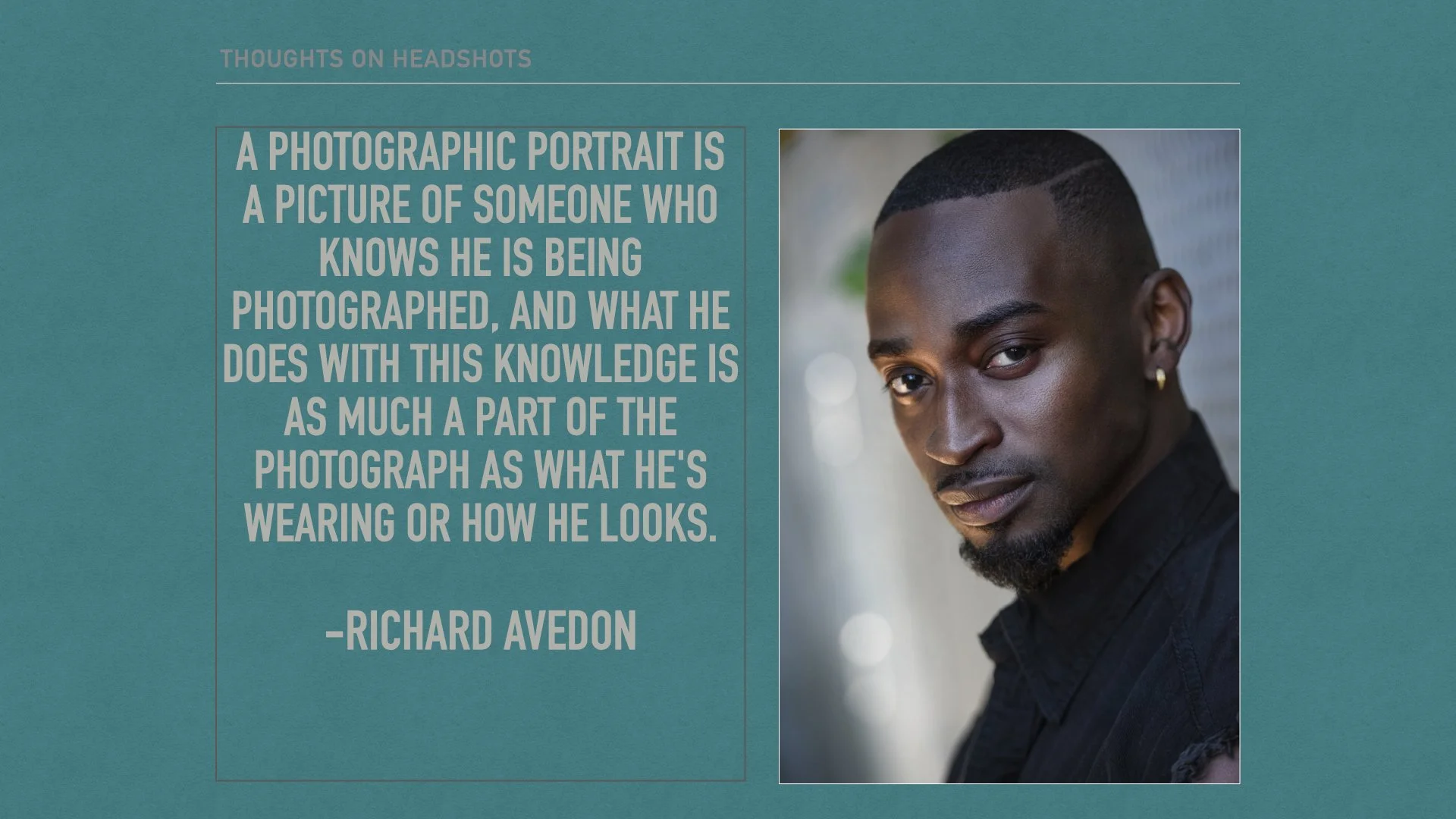
Richard Avedon put it beautifully: a portrait is a picture of someone who knows they’re being photographed, and what they do with that knowledge is part of the photograph.
That’s why headshots are acting, in a way. Not big acting. Not “playing a scene.”
More like letting a real thought live just behind your eyes.
4) Two simple hacks to get better expressions
Here are two tools that reliably help actors look more connected on camera.
Hack #1: Cast the camera as your scene partner
Pick an appropriate scene that fits the world of the shot. Then imagine the moment right before something big happens, and the moment right after.
Play both sides, quietly. Let it tick behind your eyes.
You’re not performing it out loud. No talking unless you want weird mouth.
You’re just giving your face a reason to exist.
This is how you avoid what I call “dead face,” that vacant look that technically photographs fine but feels like nobody’s home.
Hack #2: Do math
Seriously. Add two or three-digit numbers in your head while looking into the lens.
Your focus will drift as you think, and then you’ll remember the camera and come back to it.
That return is often the moment. Connected. Present. Human.
Do you need to feel something emotional? Not really.
You just need the shot to look like you do, or can. I’ll help you get there.
Actors already know this from performance. Some nights you feel everything. Some nights you’re thinking about groceries.
The audience doesn’t know the difference because you’ve learned how to register truth without relying on real-time emotion.
Headshots work the same way.
5) Why some “nice” headshots still don’t work
A headshot can be technically beautiful and still fail its job. Two common reasons:
1. Pleasant, but forgettable
There’s nothing to stay with. No tension. No openness. No invitation to imagine who they’re meeting.
It’s fine. It’s just not sticky.
2. Trendy, but interchangeable
Sometimes the photographer’s signature look becomes the point. It’s cool, it’s fashionable, it’s everywhere, and then… every actor starts to look like the same actor.
Quick story: I was at Reproductions once picking up prints. Two different stacks on the counter. Two different names.
And the headshots were basically identical. Same background, same light, same framing, same styling. I honestly couldn’t tell the actors apart until I got close.
That’s the danger. Casting isn’t trying to solve a puzzle. They’ll move on.
So what makes someone click?
Clarity first.
If casting can immediately tell who you are and where you might fit, the image earns attention.
A strong thumbnail feels readable, alive, and intentional without asking the viewer to work. Then the full-sized image confirms it with detail.
If the headshot says: here is a real person. Clear. Present. Specific. Someone you might want to meet.
There’s a good chance it earns the click, and the rest of your materials finally get a chance to do their job.
If You Want to Go Deeper
What Is a Cinematic Headshot?
Why “cinematic” is not dramatic. It’s intentional, readable, and human.Specificity First: How Headshots Actually Open Doors
Why headshots give casting a starting point, not proof of your range.Do You Really Need a “Theatre Headshot”? Let’s Clear This Up
Why presence and readability matter more than neutrality.Headshot Prep: What Actually Helps (And What Usually Gets in the Way)
How wardrobe, grooming, and prep support the hero without competing.
If you want to talk through your headshots or book a session, click here. We’ll start with a conversation.